The best battery for inverter backup depends on your electricity consumption, required backup duration, inverter compatibility and budget. For homes experiencing frequent power outages, LiFePO4 lithium batteries are often a strong choice because of their usable energy, cycle-life potential and low routine maintenance. Tubular lead-acid batteries remain practical for households seeking a lower initial investment.
However, not every battery works with every inverter. Battery voltage, charging settings, discharge current and power requirements must match the equipment. Choosing a suitable inverter battery therefore starts with understanding your actual backup needs rather than selecting the highest Ah rating.
Which Battery Type Is Best for a Home Inverter?
The most common choices for household inverters include tubular lead-acid, AGM, gel and lithium batteries. Each technology has different advantages depending on how frequently the battery is charged and discharged.
| Battery Type | Main Advantage | Main Limitation | Suitable Use |
| Tubular lead-acid | Lower initial cost | Maintenance and discharge limitations | Budget home backup |
| AGM | Sealed and low routine maintenance | Often less suited to frequent deep cycling | Occasional backup |
| Gel | Sealed design | Sensitive to charging settings | Compatible standby systems |
| LiFePO4 | High usable capacity and long cycle-life potential | Higher initial cost and compatibility requirements | Frequent daily backup |
| Other lithium-ion | High energy density | Model-specific safety and charging requirements | Approved storage systems |
For regular household load-shedding, a suitable tubular battery or LiFePO4 battery is often worth evaluating first. The best option ultimately depends on expected cycling frequency, installation conditions and the inverter’s supported battery chemistry.
Tubular Batteries: A Practical Choice for Budget Backup
Tubular lead-acid batteries are widely used with home inverter systems because they are designed for repeated charging and discharging. Their relatively lower initial purchase cost makes them attractive for households operating fans, lights and other essential appliances during occasional outages.
However, flooded tubular batteries generally require distilled-water maintenance and suitable ventilation. They also provide less usable energy when conservative discharge limits are used to protect long-term battery life.
For an inverter that already supports lead-acid charging, tubular batteries may provide a straightforward replacement option. Buyers should still check the battery’s capacity rating, recommended charging current and installation requirements. The same technology is discussed in tubular battery for UPS, although UPS applications and home inverter systems may have different charging and backup requirements.
LiFePO4 Batteries: Better Suited to Frequent Cycling
LiFePO4 batteries are increasingly used in home backup systems because they generally support a greater usable portion of nominal capacity than conventional lead-acid batteries.
They also offer long cycle-life potential, relatively high charging efficiency and minimal routine physical maintenance. These characteristics can be valuable when batteries discharge regularly during load-shedding and recharge between outages.
Lithium batteries require compatible charging equipment and appropriate electronic protection. A battery management system helps monitor cell voltage, current and temperature, but it does not make an otherwise incompatible inverter safe to use.
Before purchasing, confirm the exact battery-inverter compatibility rather than assuming that any lithium battery will work. Buyers considering this chemistry for existing backup equipment can also review lithium battery for UPS and LiFePO4 battery for UPS.
AGM and Gel Batteries: When Do They Make Sense?
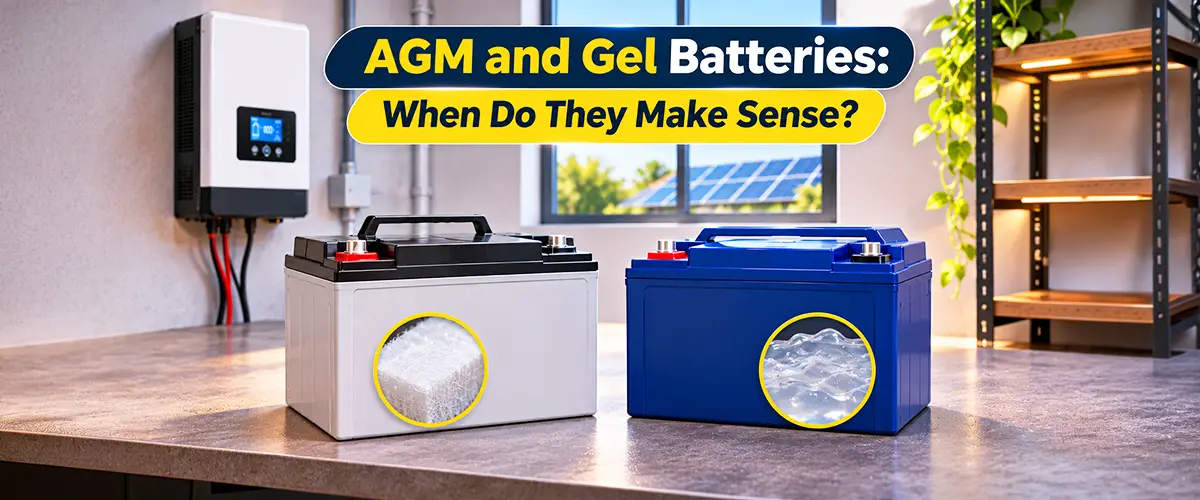
AGM and gel batteries are sealed lead-acid technologies that do not require routine water refilling. They can be useful where maintenance access is limited and the inverter supports the correct charging profile.
An AGM battery is often suitable for standby applications, while a gel battery requires carefully controlled charging voltage to avoid damage.
Neither should automatically be considered a direct replacement for a flooded tubular battery. Their charging requirements, capacity ratings and deep-cycle performance may differ. For homes that depend on battery backup every day, compare the manufacturer’s cycling specifications before choosing a sealed lead-acid option.
How Much Battery Capacity Does Your Inverter Need?
A battery must store enough energy to support the connected appliances for the desired number of hours. The inverter’s power rating alone does not determine battery capacity.
For example, consider a household using:
| Appliance | Power Consumption |
| 2 fans | 120W |
| 4 LED lights | 40W |
| Internet router | 15W |
| Other small devices | 25W |
| Total load | 200W |
If these appliances must operate for four hours, the required AC energy is:
200W × 4 hours = 800Wh
Assuming 85% inverter efficiency and a 50% depth-of-discharge limit for a lead-acid battery:
Required Nominal Energy = 800 ÷ (0.85 × 0.50) ≈ 1,882Wh
For a compatible LiFePO4 battery using illustrative assumptions of 90% inverter efficiency and 80% depth of discharge:
Required Nominal Energy = 800 ÷ (0.90 × 0.80) ≈ 1,111Wh
These estimates show why two different battery chemistries may require different nominal capacities for the same backup target. Actual results depend on battery discharge performance, equipment losses and manufacturer limits. For more detailed calculations, use inverter battery backup time and how to calculate battery capacity.
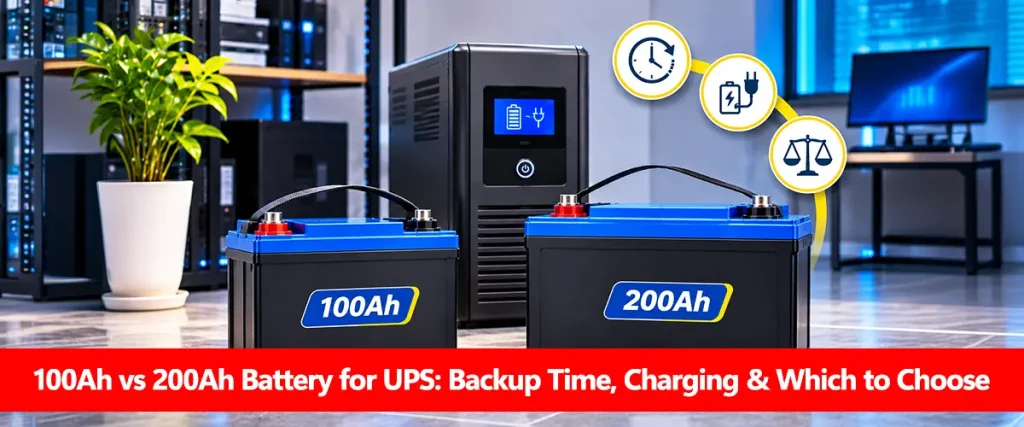
Does a 150Ah or 200Ah Battery Give Better Backup?
At the same nominal voltage and under similar conditions, a 200Ah battery generally stores more energy than a 150Ah battery. However, higher capacity does not automatically mean better value for every household.
A smaller battery may be sufficient for short outages with light loads, while longer backup requirements may justify greater capacity.
Understanding what Ah means on a battery and battery watt-hours helps compare storage sizes correctly.
For high-power appliances, battery discharge-current limits also matter. Even a large-capacity battery may be unsuitable if its maximum continuous output cannot support the connected load.
Battery Voltage and Inverter Compatibility
Home inverters commonly use nominal 12V, 24V or 48V battery systems. The battery bank must match the inverter’s approved operating voltage range.
A nominal 24V lead-acid installation may use two compatible 12V batteries in series, while a nominal 48V installation may use four. Some lithium systems instead use integrated 25.6V or 51.2V modules.
The correct configuration depends on the exact equipment and battery chemistry.
Before purchasing, verify:
- Battery voltage and operating range.
- Maximum charging and discharge current.
- Compatible charging profile.
- Continuous output and starting-surge requirements.
- Supported battery-bank configuration.
- Lithium BMS communication requirements, where applicable.
The 12V vs 24V vs 48V battery system guide explains voltage selection, while batteries in series vs parallel covers battery-bank connections. Never mix incompatible chemistries or connect additional batteries beyond manufacturer-approved limits.
What Matters More: Battery Lifespan or Initial Price?
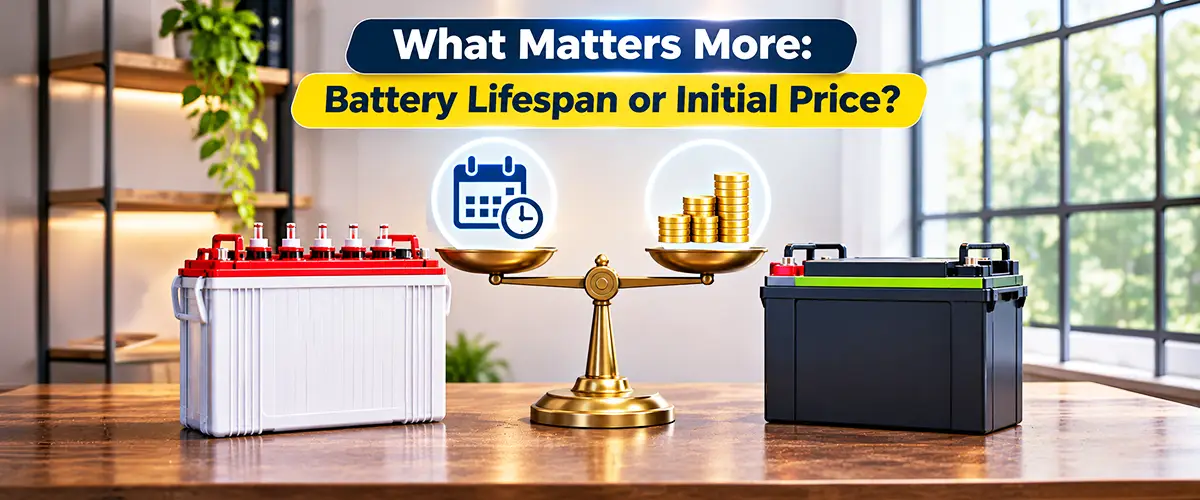
The least expensive battery is not always the lowest-cost option over several years. For systems used daily, replacement frequency and usable energy can substantially affect the total ownership cost.
Tubular lead-acid batteries often require a smaller initial investment. LiFePO4 batteries typically cost more upfront but may deliver more lifetime energy when correctly installed and operated.
| Buying Factor | Tubular Lead-Acid | LiFePO4 |
| Initial cost | Generally lower | Generally higher |
| Usable energy | Often more restricted | Generally higher |
| Cycle-life potential | Usually lower with frequent deep cycling | Generally higher |
| Routine maintenance | Required for flooded types | Minimal physical maintenance |
| Installation space | More for comparable usable energy | Generally less |
| Charging compatibility | Common in traditional inverters | Requires approved settings and protection |
Actual lifespan depends on battery quality, temperature and usage. Compare the manufacturer’s battery cycle life rating at a specified depth of discharge rather than relying only on advertised years.
Check Battery Warranty and Safety Before Buying
A useful battery warranty should clearly identify the covered model, duration, exclusions and claim process. For lithium batteries, also check any stated remaining-capacity guarantee and energy-throughput conditions.
Safety specifications are equally important. Flooded lead-acid batteries need proper ventilation and maintenance, while lithium systems require compatible protection and charging controls.
Battery installation areas should be protected from excessive heat, moisture and physical damage. Follow manufacturer limits for charging temperature and current, and have battery-bank wiring and protection installed by a qualified professional.
The correct battery charging voltage is especially important when upgrading from lead-acid to lithium. Our lead-acid charger for lithium battery guide explains why identical nominal voltage does not guarantee charging compatibility.
Best Inverter Battery by Household Requirement
A practical way to choose is to match battery chemistry to the expected operating pattern.
| Requirement | Battery to Consider |
| Occasional load-shedding | Compatible tubular lead-acid |
| Frequent daily power outages | LiFePO4 |
| Lower initial budget | Tubular lead-acid |
| Minimal routine maintenance | LiFePO4 or suitable sealed battery |
| Long backup duration | Correctly sized deep-cycle battery bank |
| Existing lead-acid inverter | Compatible lead-acid or approved lithium upgrade |
| Home solar and inverter backup | Compatible LiFePO4 or deep-cycle storage |
If sensitive electronics require near-continuous power, the switching performance of the equipment is also important. The UPS vs inverter guide explains these differences, while best battery for UPS covers requirements specific to UPS equipment.
Final Inverter Battery Buying Checklist
Before buying a battery for your inverter, confirm the requirements of the complete backup system.
- Calculate the load: Add the running watts of appliances that need backup.
- Set backup duration: Decide how many hours the appliances must operate.
- Determine usable capacity: Consider discharge limits and inverter efficiency.
- Match voltage: Confirm the inverter’s supported battery voltage.
- Choose compatible chemistry: Check the charger and battery specifications.
- Check power output: Verify discharge current and starting-surge requirements.
- Review lifespan and warranty: Compare written manufacturer ratings.
- Include installation costs: Consider wiring, protection, ventilation and service.
- Verify after-sales support: Use an authorized installer or supplier where possible.
A properly designed battery bank can provide better reliability than simply choosing the largest Ah rating. For homes that also use photovoltaic panels, solar battery sizing adds the solar charging and storage considerations.
Conclusion
The best battery for inverter backup depends on how often the battery is used, how much electricity must be supplied and whether the inverter supports the selected chemistry.
LiFePO4 is often a strong option for frequent cycling and low-maintenance household backup. Tubular lead-acid remains practical for budget-conscious installations with compatible charging equipment, while AGM and gel batteries suit selected standby applications. Choose a battery by usable capacity, output capability, charging compatibility, warranty and total ownership cost—not initial price or Ah rating alone.
Frequently Asked Questions
Which Battery Is Best for a Home Inverter?
LiFePO4 is often suitable for frequent daily backup, while a compatible tubular lead-acid battery can be practical for a lower initial budget. The inverter’s charging requirements must guide the decision.
Is a Tubular Battery Better Than Lithium for an Inverter?
Tubular batteries generally cost less initially, while lithium batteries often offer higher usable capacity, longer cycle-life potential and reduced maintenance. The better choice depends on usage and inverter compatibility.
Is a 150Ah or 200Ah Battery Better for an Inverter?
At the same voltage, a 200Ah battery generally stores more nominal energy. However, the appropriate capacity depends on connected load, backup duration and the inverter’s charging capability.
Can I Use a Lithium Battery With My Existing Inverter?
Only if the inverter supports the lithium battery’s voltage range, charging profile, discharge limits and BMS requirements. Some older systems may need equipment upgrades.
Which Battery Gives the Longest Backup Time?
Backup duration depends on usable stored energy, load and inverter efficiency rather than chemistry alone. A correctly sized battery bank provides the required runtime.
Is a Car Battery Suitable for an Inverter?
Conventional car starting batteries are generally not ideal for repeated deep cycling. Suitable deep-cycle batteries are usually more appropriate for regular home backup.
How Long Does an Inverter Battery Last?
Service life depends on chemistry, discharge frequency, temperature and charging conditions. Proper maintenance and avoiding excessive discharge help improve longevity.
Which Is Better for Inverter Backup: AGM or Tubular?
Tubular lead-acid batteries are often considered for extended home backup, while AGM batteries can suit sealed, lower-maintenance applications. The exact battery specifications and charging compatibility determine suitability.
Does a Bigger Battery Increase Inverter Power?
No. A larger battery can increase available stored energy, but the inverter’s watt and surge ratings still determine the maximum supported load.